Why Do I Love Golf?

This is a guest post by Scott McCormick.  I believe it does a great job of high­light­ing why we remain ded­i­cated to this crazy game! Scott McCormick is a free­lance writer for Golf Now Dal­las. For more of McCormick’s golf com­men­tary, see his recent post ana­lyz­ing the swing of Mas­ters win­ner Adam Scott.

Are you ever on the golf course and things aren’t going well, and you ask your­self … what am I even doing out here with this stick in my hand and a lit­tle white ball in the weeds?

Why do I even bother play­ing this dumb game?

What am I try­ing to accom­plish with this round?

What the hell is the point?

I feel like that some­times, but it usu­ally goes away pretty quickly (as soon as I make a good swing, every­thing wrong with the world seems to be erased).  Other times, I do won­der why I devote so much of my life to a silly game, but I’ve got­ten pretty good at ratio­nal­iz­ing my devo­tion and phi­los­o­phiz­ing about the inher­ent val­ues the game has imprinted on my psyche.

Here are some of the things I’ve come up with to explain my love and ded­i­ca­tion to the sport of golf:

Dig­nity and Pride

I look back to when I first started play­ing golf as a child and I couldn’t even hit the ball most of the time.  I knew noth­ing about the game.  Even after sev­eral years of play­ing, I was still hor­ri­ble.  Pathetic.  My swing mechan­ics were atro­cious.  I had absolutely no shot-making skills what­so­ever.  I could barely drive the ball 150 yards, and when I did they were usu­ally shanks or slices.

But year upon year, hour after hour, I got bet­ter.  I remem­ber my first birdie and those irre­place­able feel­ings of hit­ting a really good shot.  I remem­ber the first time I broke 100, and later 90.  Aside from the joy of get­ting mar­ried and hav­ing chil­dren, I can’t think of any feel­ings that have come close to match­ing the best feel­ings I have felt on the golf course.  I have felt more proud of a golf swing than I have about most of my pro­fes­sional work, which hasn’t been insignif­i­cant.  There’s just some­thing about golf that makes me feel good, so good that it makes up for the times when golf makes me feel like shit.

Pres­tige

Golf is rich and tra­di­tion and has his­tor­i­cally been asso­ci­ated with the upper crust of soci­ety.  Now I have always been decid­edly mid­dle class, maybe even lower-middle class, but I get a kick out of the sen­sa­tion I get when I’m on the golf course that makes me feel that I am at the top of the social lad­der.  It’s not that I have a desire to get all hoity-toity or holier-than-thou, it’s just that golf gives me a sense of self-esteem, that I am con­nected to some­thing big­ger and deeper than myself.

Men­tal acuity

I’ve noticed that my love of golf has caused me to develop a focus and a men­tal for­ti­tude that has car­ried over into other areas of my life.  At the risk of sound­ing tacky, I whole­heart­edly believe that the game has improved my all around men­tal sta­mina, cere­bral well­be­ing, and my entire out­look on life has been enhanced by this silly lit­tle game.

It’s always a bit silly when peo­ple try to make their lit­tle games or sports as a metaphor for this, that or the other thing, but I don’t care.  Call me silly.  The ups and downs that every golfer faces are not unlike the ups and downs that every­one faces in life.  By learn­ing to per­se­vere through the down times on the course, I am able to do that in other areas of my life.

Fun and Enjoyment

Every­one needs diver­sions.  While some peo­ple pre­fer tele­vi­sion or movies as their dis­trac­tion, I snub my nose at those peo­ple and haugh­tily assert that my hob­bies and inter­ests are inher­ently bet­ter than oth­ers.  I rec­og­nize the irra­tional­ity of that stance, but at the end of the day we all do that a lit­tle bit.

The bot­tom line is, for me, golf is really damn fun.  I enjoy it.  Even when I’m curs­ing the game and wish­ing I had never picked up a club, I’m hav­ing a good time.  Really.  I may not real­ize it at the time while I’m hoot­ing and hol­ler­ing about a missed putt, but I love it all the same.

Shaking Off the Rust

5-13-2013

North­wood Golf Club — May 13th, 2013

As I stated in 5 Rea­sons to Join a Golf League, I believe play­ing in a golf league is a great way to improve your game. I did not play in a golf league last year as I decided to join a golf club close to my home that does not offer a late after­noon league. I really missed it and this year a group of guys from work and I decided to join a league at North­wood Golf Club. Last Mon­day night was the start of this year’s league. My analy­sis of the round fol­lows below. I plan to ana­lyze and post on all my weekly rounds this year.

The first night of league this year was played on the back nine. I had played the front nine a few years ago but had never played the back nine at North­wood. I remem­bered the course as being tight and not for­giv­ing of errant tee shots. Most of the courses around me just opened on the prior Sat­ur­day, so this was going to be my first round of the year. With it being my first time out for the year and on a new course, I wasn’t sure what to expect!

As you can see from my score­card above, I shot a 53. Even so, there are good things I can take from this round. I bogeyed seven holes of which two should have been easy pars (more on that later). Let’s first talk about a few things that need imme­di­ate attention.

The most glar­ing thing on the score­card are the two nines on hole 12 and 18. Blow-up holes must be avoided if you expect to play bogey golf. If I was able to even dou­ble bogey 12 and 18, and turn those nines into sixes, I would have posted a 47. Given the cir­cum­stances, I would have been pleased with a 47 on Mon­day night. The way to avoid blow-up holes is to not com­pound mis­takes on a hole. On the twelve hole, I actu­ally hit a decent drive that ran through the fair­way, not leav­ing me a shot to the green. I tried to do too much with my sec­ond shot and failed to clear the cor­ner and was forced to advance the ball up the fair­way with my third shot. Now I’m hit­ting four from 162 yards out. I dead pull a six iron left into the woods, end up three putting and take a nine on the hole. On 18, I blocked my dri­ver off the tee into the woods to the right. I recov­ered nicely by re-hitting my drive down the mid­dle of the fair­way. I put my fourth shot into a green side bunker. The sand was packed fairly hard (no excuse) and I bladed my fifth shot over the green and bunker on the other side. My next pitch came up a yard short, hit the lip of the bunker and rolled back in. I got on with my next shot and two putted for a nine.

There are a few lessons to be learned here. First, you must go into dam­age con­trol mode after your first bad shot on a hole. You need to limit the dam­age to at worst a dou­ble bogey. It is nearly impos­si­ble for a high hand­i­cap or even bogey golfer to recover their round after an eight or nine on a hole. Your next shots need to be smart, safe shots that do not attempt to make up for your pre­vi­ous bad shot. Sec­ond, you need to keep your head in the present shot to exe­cute a sound shot. What’s done is done. Con­cen­trate on the present shot. Blow-up holes are caused by com­pound­ing a bad shot on top of a pre­vi­ous bad shot. Elim­i­nate this and you will elim­i­nate blow-up holes.

The other thing that jumps out on my score­card is the three three putts. Twenty putts are sim­ply too many putts for nine holes. The greens were in rough shape as they need a few more weeks of sun to come around so I wasn’t expect­ing to make putts of any dis­tance. Two of my three putts came from miss­ing putts for par that were less than three feet. You have to make the short putts if you plan to score well. I hit two greens in reg­u­la­tion but three-putted them both, turn­ing pos­si­ble birdies and sure pars into bogeys. I’ll be allot­ting extra time for prac­tic­ing short putts into my weekly prac­tice sessions.

I was over­all happy with my ball strik­ing from tee to green. I hit 43% of my fair­ways and 22% of my greens. On three of the greens, I was just a few yards long. I started using a Wil­son Duo golf ball this year and I’m won­der­ing if its lower com­pres­sion is giv­ing me a few more yards.

While I’m not thrilled with an open­ing 53 for the year and expect improve­ment for the next week, I actu­ally played well for much of the round. My mis­takes were eas­ily iden­ti­fi­able and I will address them accord­ingly. I look for­ward to my next league night where I hope to see bet­ter results in terms of score.

How to Afford Golf Lessons

On a recent Shoot­ing 90 poll, I asked the ques­tion “What’s the biggest thing stop­ping you from lessons with a PGA pro­fes­sional?”. As of writ­ing this post, over 75% of the respon­dents answered “It’s too expen­sive for me”. Other choices included “I don’t have the time”, “I’m too embar­rassed”, and “I don’t need lessons!”.

The expense of golf lessons being by far the most pop­u­lar answer took me a bit by sur­prise. While I can make the argu­ment for each answer not being a viable rea­son (excuse), I was expect­ing not hav­ing the time as the most pop­u­lar response.

Golf is an expen­sive sport to begin with. Most likely you’ve already invested hun­dreds of dol­lars into a set of clubs. While a set of clubs can last you sev­eral years, what about your cost every time you golf a round of 18 holes? Add up green fees, replac­ing lost balls, and refresh­ments, and you talk­ing at least $60, maybe more depend­ing on where you live. I under­stand you can golf dur­ing twi­light hours for $20, just drink water (which is best for you any­ways), and bring your total cost to under $30, but the point I’m try­ing to make is that golf costs you a sig­nif­i­cant amount of money every time you play a round.

I will ven­ture to say that most high hand­i­cap golfers play too much and prac­tice too lit­tle, which is fine if you do not want to improve and are get­ting enough enjoy­ment from your curent game. The fact is golf is more enjoy­able for a high hand­i­cap golfer after they improve their game, and you read­ing this post tells me you have a desire to improve.

What if instead of golf­ing one of your rounds per month, you take what you would have spent and invest in golf lessons? The aver­age cost of one hour of lessons with a golf teach­ing pro­fes­sional in my area is $65. Most pros will also let you split the hour into two half hour ses­sions. For $65 per month, you could meet every two weeks with a golf coach. Think how more quickly your golf game could improve. A golf teach­ing pro­fes­sional could put you on the fast track to going from a high hand­i­cap to shoot­ing 90.

While I’m a firm believer that one-on-one golf lessons from a teach­ing pro­fes­sional is the best form of instruc­tion, there are even less expen­sive ways to get instruc­tion from a pro. Many pro golf instruc­tors adver­tise a lower rate for group instruc­tion. Ask your local pro if they are will­ing to do low­ered group rates if they do not state it. Form a group with your spouse or a cou­ple of bud­dies. You still get time with a teach­ing pro­fes­sional but at a reduced rate. If you need to bring the cost down even fur­ther, you could attend one of sev­eral clin­ics that most teach­ing pro­fes­sion­als put on dur­ing the sea­son. I can attend golf clin­ics in my area for as lit­tle as $15.

Hope­fully I have influ­enced the peo­ple who think lessons from a pro­fes­sional golf teacher are too expen­sive into tak­ing another look. I believe the fastest route for a high hand­i­cap golf to improve their game and enjoy golf more is with the help of a golf professional.

The 2013 Masters

I, like many of you, enjoyed watch­ing the 2013 Mas­ters. It was a great win for Adam Scott. I always watch pro­fes­sional tour­na­ments look­ing for tips I can apply to my own game. While there are things the pros do that we should not, there are just as many things we can apply to our own games.

Here are some thoughts of mine from the 2013 Masters.

Down­hill putts will break more than uphill putts. How many times did the pros not play enough break on make-able down­hill putts and the ball broke below the hole? I’m not talk­ing about long putts that they were try­ing to lag putt. On those putts the wanted out­come is leav­ing the ball below the hole to have an uphill putt on their next one. Granted, the greens at Augusta were insanely fast, espe­cially on Fri­day and Sat­ur­day, but to see pro­fes­sional golfers con­tin­u­ally not play enough break  on putts they were try­ing to hole was inter­est­ing. It serves as a great reminder for high hand­i­cap and begin­ner golfers who gen­er­ally do not play enough break to begin with. While the greens will not be as fast as a pro­fes­sional event, remem­ber that down­hill putts will take more break than uphill ones.

On Sun­day, as a steady rain fell, the greens became con­sis­tently slower. Many pros were slow to adjust and putt after putt came up short of the hole. This brought a cou­ple of thoughts to mind. First, I was some­what sur­prised how long it took some pros to adjust. Sec­ond, it reminded me of the say­ing that you won’t make a putt that doesn’t reach the cup. Again, I’m not talk­ing about the times when lag putting the ball up to the hole was the best approach. Rather I’m talk­ing of the times where the pros were expect­ing to make the putt. There were sev­eral putts on Sun­day that were a rev­o­lu­tion or two from going in the hole. Who can say how that affected the out­come. Adam Scott had it fig­ured out by the time he reached the 18th hole and the play­offs sink­ing the two biggest putts of his career. When you have a putt you are expect­ing to sink, make sure you get it to the hole.

Finally, the sports­man­ship between Adam Scott and Angel Cabr­era was enjoy­able to watch. I’m sure the fact that they were team­mates on the 2009 President’s Cup team and con­sider them­selves friends had some­thing to do with it. More so I believe it points to the out­stand­ing char­ac­ter of these two com­peti­tors. Take a cue from Adam Scott and Angel Cabr­era the next time you’re com­pet­ing in your flight of your club cham­pi­onship or in your weekly league. Com­pete hard but main­tain the utmost respect for your com­peti­tor, win or lose.

I plan on post­ing my obser­va­tions on other tour­na­ments as the sea­son pro­gresses. There is always some­thing to learn from watch­ing the best golfers in the world.

5 Reasons to Join a Golf League

Have you been con­sid­er­ing join­ing a golf league? Have you been hes­i­tant because you are a begin­ner or high hand­i­cap golfer? Actu­ally play­ing in a golf league is a great way to improve your game. Here’s five rea­sons why you should join a golf league!

1. A golf league is fun!

Some­times we need to remem­ber that golf is a game and is to be enjoyed. You’ll meet and get to know many other golfers through the dura­tion of the league. You’ll get to play other two-person teams out on the course and social­ize with the entire league at the 19th hole after­ward. A golf league is a great way to net­work for both friend­ships and busi­ness connections.

2. You are able to com­pete on an even play­ing field.

Golf allows you to estab­lish a hand­i­cap which is applied against what­ever course you are play­ing on. Your oppo­nent also has a hand­i­cap. Depend­ing on the dif­fer­ence in hand­i­caps, you will either receive or give strokes for the round. What holes you give or receive the strokes on depends on the hand­i­cap rat­ing of each hole. Gen­er­ally the more dif­fi­cult holes are the ones with the low­est hand­i­cap rat­ing and the ones where you will give or receive strokes. Hand­i­caps allow golfers of all skill lev­els to com­pete against one another.

3. Friendly com­pe­ti­tion dri­ves you to improve your game.

It’s human nature that none of us like to lose. The desire to golf well in league will pro­duce more focused prac­tice ses­sions. I’m not say­ing you nec­es­sar­ily need to be the best golfer in your league but you will feel the desire to improve your play in your league. Many golf leagues rec­og­nize the most improved player for the sea­son so you may be rewarded for your efforts!

4. You have a weekly sched­uled time to golf.

We all live busy lives. Some­times find­ing time to golf is chal­leng­ing. By com­mit­ting to play in a league, you are insur­ing you will golf at least once a week. Addi­tional prac­tice time on the range is very impor­tant, but just as impor­tant is golf­ing on a con­sis­tent basis. Your swing is just part of your golf game. Only on the course will you get the valu­able expe­ri­ence in course man­age­ment needed to improve your game.

5. Learn from golf­ing with bet­ter players.

As a begin­ner or high hand­i­cap golfer, part­ner with some­one who is slightly bet­ter than you are, maybe some­one who is close to or already shoot­ing 90. Golf­ing with bet­ter golfers will help you improve your game by watch­ing how they man­age their way around the course. The key is to find some­one to golf with who is bet­ter than you but not so much bet­ter that you are intim­i­dated play­ing with them.

I hope I’ve con­vinced you of the ben­e­fits of join­ing a golf league. It’s a great way to both fur­ther your enjoy­ment of the game and improve your skills.

Golf GPS Systems vs Laser Rangefinders

There is no rea­son for ama­teur golfers to con­tinue to rely on on-course yardage mark­ers in today’s world. Mark­ing off the actual yardage from your ball to a yardage marker is inac­cu­rate and time con­sum­ing. There are two dis­tinctly dif­fer­ent devices avail­able on the mar­ket to help you deter­mine yardage on the course; the golf GPS sys­tem and the laser rangefinder.

Which one is right for the begin­ner or high hand­i­cap golfer?

First, let’s take a detailed look at each.

Golf GPS sys­tems uti­lize the same GPS satel­lite sys­tem that a car nav­i­ga­tion sys­tem does. GPS coor­di­nates must be mapped for each course that the man­u­fac­turer offers on the device. This is pri­mar­ily done through the use of satel­lite images but Sky Golf, maker of Sky Cad­die sys­tems, prides itself on walk­ing every course. The accu­racy of a golf GPS sys­tem is usu­ally within a few yards with the Sky Cad­die sys­tems claim­ing even bet­ter accu­racy. Using these GPS coor­di­nates, the device can tell you the dis­tance from your ball to var­i­ous points on the hole. The most basic of sys­tems tell you the dis­tance to the cen­ter of the green. Most tell you at least the dis­tance to the front, cen­ter, and back of the green while some offer more includ­ing the dis­tance needed to carry haz­ards. An over­head view of the hole is another fea­ture on some sys­tems. Most of the touch­screen mod­els offer the abil­ity to drag to any point on the hole and see the dis­tance to it.

A laser rangefinder shoots a laser off an object to deter­mine the dis­tance to it. By far the biggest ben­e­fit of a laser rangefinder is its accu­racy in mea­sur­ing the dis­tance to the flag. Sev­eral rangefind­ers boast of accu­racy within one yard or less. A sec­ondary advan­tage of some rangefind­ers is the abil­ity to deter­mine the slope from your ball to the tar­get and fac­tor it into the dis­tance. So if the actual dis­tance is 150 yards but the tar­get is uphill, the device would also give a longer “play-as” yardage. Rangefind­ers are also able to lock onto tar­gets other than the flag, although this can some­times be trick­ier and take more time. The major draw­back of a laser rangefinder is the fact that it can­not mea­sure the dis­tance to a tar­get that it can­not see. So any blind shots are not measurable.

So which device is bet­ter for the high hand­i­cap or begin­ner golfer?

A golf GPS sys­tem is the best choice for the begin­ner or high hand­i­cap golfer. There are sev­eral rea­sons why.

  • The goal of a high hand­i­cap golfer is to hit greens in reg­u­la­tion – not to go for every flag. Many times holes are guarded by haz­ards and the safe play is an area of the green away from the hole. A golf GPS sys­tem that tells you the dis­tance to the front, cen­ter, and back of the green will help you think of the dis­tance remain­ing to the green as a yardage range instead of a spe­cific yardage, help­ing you hit more greens.


  • Many golf GPS sys­tems show an over­head view of the hole. Visu­al­iza­tion is a cru­cial com­po­nent of being a suc­cess­ful golfer. An over­head view of the hole is highly ben­e­fi­cial in uti­liz­ing course man­age­ment to plan out your shots on each hole.


  • A golf GPS sys­tem is quicker than a laser rangefinder. Slow play is becom­ing an increas­ingly larger prob­lem in golf. It takes time to zero in on a tar­get with a laser rangefinder. A GPS will instantly tell you the remain­ing yardage to the green.


  • You can keep score and track stats on many golf GPS sys­tems. In addi­tion to deter­min­ing yardage left to the green and haz­ards, many golf GPS sys­tems allow you to keep score and track stats.


While hope­fully some­day your golf game will progress to a level that requires the accu­racy of a laser rangefinder, it is sim­ply not nec­es­sary at the high hand­i­cap level. The added ben­e­fits of a golf GPS sys­tem make it the easy choice for the begin­ner or high hand­i­cap golfer.

 Click here for golf GPS systems

Practice Year Round at an Indoor Golf Facility

This past week­end, my wife and I made the four hour trip from our home in north­ern Wis­con­sin to Min­neapo­lis. Most of the week­end was spent attend­ing a trade show for my wife’s busi­ness. Even so it was a nice get­away and we did find time to have some fun.

I found time Sat­ur­day after­noon to have a great time at Inside Edge Golf, an indoor golf facil­ity in Eden Prairie, MN. It was my first trip to such a facil­ity. I had pre­vi­ously inter­acted with @insideedgegolf on Twit­ter, and since I knew I was going to the Twin Cities, I jumped at the chance to check it out.

Inside Edge Golf has nine about­Golf PGA Tour sim­u­la­tors. Seven of the sim­u­la­tors are Clas­sic mod­els, one is a Widescreen (5 feet wider screen than the Clas­sic), and one is a three-screen Sim­Sur­round. Each sim­u­la­tor has incred­i­ble 3D graph­ics and offer the choice of over 50 world famous courses to play. Inside Edge Golf also has an 1800 square foot putting green.

I knew I would not have a lot of time but still wanted to expe­ri­ence both a sim­u­la­tor and the putting green so ear­lier in the week I reserved a half hour on a Clas­sic Sim­u­la­tor and a half hour on the putting green. Inside Edge rec­om­mends reserv­ing sim­u­la­tor time three to four days in advance, espe­cially for week­end times.

The sim­u­la­tors are incred­i­bly easy to use. The staff at Inside Edge was extremely friendly in explain­ing the sim­u­la­tor and answer­ing any ques­tions. I first warmed up with a few shots in prac­tice range mode. It was my first time on a sim­u­la­tor so obvi­ously I was going to play an actual course, but if I had the abil­ity to visit Inside Edge on a reg­u­lar basis, I could see myself reserv­ing sim­u­la­tor time for the sole pur­pose of hit­ting balls on the range. The sim­u­la­tor records all of the impor­tant data such as club­head speed, ball speed, ball spin, pro­jected tra­jec­tory and dis­tance. The instant feed­back after every shot is instru­men­tal in improv­ing your results. Lessons are even avail­able on a sim­u­la­tor from an on staff PGA professional.

As I men­tioned ear­lier, there are over fifty courses to choose from. I chose TPC Scotts­dale, prob­a­bly because it was fresh in my mind from the recent Waste Man­age­ment Open. I only had a half hour so I wasn’t able to get a whole round in but was able to fin­ish 11 holes. Any­thing within 12 feet of the hole is con­sid­ered a gimme. This speeds up play and makes total sense since the strength of the sim­u­la­tor is the analy­sis of full swings. On the floor of the sim­u­la­tor is an area with a tee, a short car­pet mat which is the fair­way, and a thicker mat which is the rough. Where you place the ball to hit depends on where you are on the screen. Play­ing a round on your favorite course is real­is­tic enough to help you work on your full swing. Since you are charged for how long you use a sim­u­la­tor, I did find myself rushed to fin­ish holes. I’m sure this being my first time had a lot to do with this and one would feel less and less rushed the more they used a simulator. Inside Edge offers league play which be a great way to break up the win­ter and keep your skills up until spring.

After the sim­u­la­tor, I spent some time on Inside Edge’s 1800 square foot putting green. It fea­tures both flat and break­ing putts along with var­i­ous lies off the side of the green to prac­tice chip­ping. There is even a mini-flop wall to per­fect your flop shots!

I rec­om­mend any­one within an hour’s drive of an indoor golf facil­ity such as Inside Edge Golf to take full advan­tage. You have the abil­ity to work on your game through­out the win­ter, on rainy days, and at night. Unfor­tu­nately I do not live close enough to an indoor golf facil­ity so I will be doing the next best thing and build­ing a sim­u­la­tor in my house before next fall.

Best Golf Balls for Beginners

A lot of peo­ple find Shoot­ing 90 by search­ing the Inter­net for the best golf balls for begin­ners. There are many dif­fer­ent golf balls on the mar­ket today. Depend­ing on how they are con­structed and the mate­ri­als used, they cater to golfers of all skill levels.

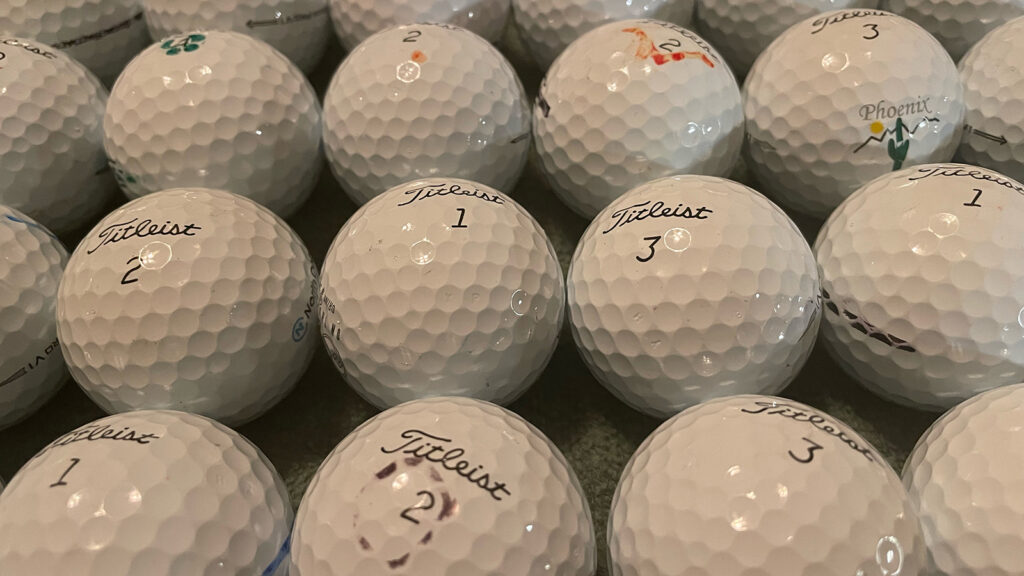
Tour balls, the same balls pro­fes­sion­als use on tour, the Titleist Pro V1 being the most pop­u­lar, are made of three, four or even five lay­ers and have a soft cover. This con­struc­tion pro­vides a high level of spin and feel around the green. Many ama­teurs, includ­ing begin­ner and high hand­i­cap golfers, emu­late the pros and use tour balls think­ing they will get an advan­tage from them. How­ever, with­out the high level of nec­es­sary skill, tour balls are not help­ing your golf game and may actu­ally be hurt­ing it.

Begin­ner golfers should start with a basic two piece ball that costs around $1. There are many rea­sons a basic two piece ball is bet­ter for a begin­ner than a tour cal­iber or other advanced ball.

  • High spin of a tour ball can mag­nify slices with a driver.

The same high level of spin that helps around the green can increase the sever­ity of your slices and hooks off the tee with your dri­ver. Begin­ner golfers are still improv­ing their shots and will occa­sion­ally hit dri­ves that result in a slice or hook. A tour ball’s high amount of spin with mag­nify these errant shots. A two piece ball has a harder cover that pro­duces less spin while using a dri­ver. Less spin off the tee will help con­trol slices and hooks.

  • Tour balls are expensive.

Let’s face facts. As a begin­ner golfer, you are going to lose your fair share of golf balls. Addi­tion­ally, golf is already an expen­sive sport. Los­ing Titleist Pro V1 balls on a reg­u­lar basis, which cost $4 a piece, unnec­es­sar­ily makes the already expen­sive sport of golf even more costly.

  • Two piece balls are more durable.

You may be ask­ing how a $1 golf ball can be more durable than a $4 golf ball but that is exactly the case! The cover of $1 two piece golf balls are made with a harder mate­r­ial than the cover of tour balls. The soft cover of a tour ball is needed for the required feel around the green. This soft mate­r­ial is more eas­ily cut by mishits than the harder mate­r­ial of the two piece ball cover.

 $1 two piece golf balls are the best golf balls for begin­ners. Click the link below for our list of two piece balls that cost around $1 a piece.

Click here for the best golf balls for beginners

Hit More Greens in Regulation by Playing it Safe

It’s fun to watch pro golfers on tele­vi­sion attack the pins and setup easy birdies. It would appear they are attack­ing the pin on every hole. Next time you watch pro­fes­sional golf, pay close atten­tion to your favorite golfer as they com­plete their round. You will see that they are very selec­tive in which flags they go for and those they do not. On some holes even the pros will avoid dan­ger and hit their approach shot to the safe side of the green, two putt for their par and move on to the next hole.

High hand­i­cap golfers need to be even more selec­tive in which pins they choose to go for. High hand­i­cap­pers sim­ply do not have the required con­sis­tent accu­racy to go for every pin. There’s noth­ing wrong with going for only some of the flags dur­ing a round. In fact, high hand­i­cap golfers need to be hit­ting greens in reg­u­la­tion to setup pars rather than fir­ing at pins to setup birdies.

The ulti­mate goal of the high hand­i­cap golfer is to reach the level of play­ing bogey golf. Mak­ing birdies, while an awe­some feel­ing, has very lit­tle to do with reach­ing this goal. Hit­ting greens in reg­u­la­tion to make pars is extremely impor­tant to off­set any dou­ble bogies or worse. There is too much risk in aim­ing at pro­tected pins. Many times pins will be placed on the side of a green pro­tected by water, rough, or sand. Hit your approach shot in the water and you’re risk­ing a blow-up hole — a round killer. Hit your approach shot in the sand or rough and you’re scram­bling to make par, most likely look­ing at a bogey. It’s much more impor­tant to hit the safe part of the green in reg­u­la­tion than to shoot for pro­tected pins.

The safest part of most greens is the mid­dle on the side away from trou­ble. If’s there’s trou­ble on the right, shoot for the left side of the mid­dle of the green. From here, the goal is to lag putt to avoid three putting the green. Effec­tive lag putting is essen­tial to improv­ing your golf game. Tak­ing pro­tected pins out of play and aim­ing for the safe area of the green will leave some longer first putts. This is OK as it is much bet­ter than miss­ing the green. It does how­ever require that you become an effec­tive lag putter.

One piece of equip­ment I believe every high hand­i­cap golfer should have is a golf GPS sys­tem. Know­ing the dis­tance to the front and back of every green is crit­i­cal to hit­ting more greens. Think­ing of the yardage remain­ing to the hole as a range instead of a sin­gle yardage makes you con­sider every pos­si­ble club and helps you choose the cor­rect one. Invest in a golf GPS sys­tem today if you do not have one.

Hope­fully you do not think I’m tak­ing the fun out of the game by sug­gest­ing to not go for pro­tected pins. The truth is there will be plenty of holes where the hole is cut in a very favor­able area of the green. Be aggres­sive and take dead aim for these flags. On the holes with pro­tected pins, remove the risk and lower your score by hit­ting the safe area of the green.

tortoise_feature

How to Avoid Slow Play in Golf

Slow play has become a large prob­lem for the game of golf. Unfor­tu­nately it is not uncom­mon for an 18 hole round of golf to take over five hours. I’m not a speed golfer but I can play a round in three hours with no traf­fic on the course. The golf indus­try would love for golfers to be able to com­plete rounds in four hours. Slow play is not directly related to being a high hand­i­cap golfer. It’s not the num­ber of strokes that one takes but instead all of the activ­ity in between. Look at the pro­fes­sional golf tours. These golfers have their liveli­hoods on the line with every shot so they have a rea­son to take their time. Still, pace of play on the pro­fes­sional tours is ago­niz­ingly slow. So while you can glean some tips from watch­ing pros on TV, don’t mimic their slow play.

So what causes slow play and what can golfers do to speed up the pace?

A big rea­son for slow play is not hav­ing a con­sis­tent, timely pre-shot rou­tine for all of your shots, includ­ing full swings, pitches, chips and putts. Hav­ing a timely rou­tine involves select­ing the right club. This requires judg­ing the dis­tance, wind, lie of the ball and ele­va­tion change to the hole. Once you have the right club, take one prac­tice swing,line up to a tar­get and take your shot. One prac­tice swing is plenty. The time for prac­tice swings is on the dri­ving range.

Putting is arguably the most impor­tant part of your golf game. More strokes are taken with your put­ter than any other club. This makes read­ing putts very impor­tant to your suc­cess. How­ever, many golfers take way too long to com­plete their pre-putt rou­tines. I believe read­ing putts requires get­ting a side view to judge ele­va­tion and a view from below the hole. I view from above the hole is also ben­e­fi­cial but only when time allows. But like the full swing pre-shot rou­tine, many times some of the reads can be com­pleted before your turn while oth­ers are read­ing their putts. While walk­ing up to the green, get a look at the gen­eral slope of the green. Then, if oth­ers are play­ing before you, get a read or two on your putt while they are read­ing theirs. Be sure to be out of the way and quiet as they line up over their ball and putt.

Iron­i­cally, another source of slow play is the rid­ing cart. Many times golfers in the same cart will ride over to one of the player’s ball on one side of the fair­way and the other per­son will wait there the whole dura­tion of the pre-shot rou­tine and shot. They will then drive over to the other player’s ball and do the same. This is too time con­sum­ing and the wrong way to play cart golf. For times when two play­ers in a cart are on oppo­site sides of the fair­way, the dri­ver should drive the pas­sen­ger to their ball. The pas­sen­ger should quickly deter­mine their club to use. If they are in between clubs, the pas­sen­ger should take both and the dri­ver should go to their ball. This way both play­ers can pre­pare and take their shots with­out a lot of unnec­es­sary waiting.

Search­ing for lost golf balls is also a source of slow play. By rule you are allowed five min­utes to search for a lost ball. Dur­ing casual play, the only time you should take five min­utes is when your ball is lost in an area where you have a next shot if you find it. For exam­ple, many times your ball can get lost in the rough. If you hit your ball in the thick woods, by all means take a minute to look for it (after all they’re expen­sive), but then take a drop since you wouldn’t have a real­is­tic next shot even if you found it. One more thing about search­ing for lost balls. Other mem­bers in the group should hit their next shots before help­ing the player search for their lost ball. Do not have your entire four­some look­ing for a lost ball before they have taken their next shots.

Keep an eye on your pace of play next time you are on the course. If the course is busy and the hole in front of you is com­pletely open, you’re prob­a­bly play­ing too slow. Make sure you are using the ideas we dis­cussed and speed up your play.